How to Pay Online Safely?
You confirm your cart, you enter your card number, you click "Pay", and within seconds the purchase goes through. It is fast and convenient, but it is also the moment that calls for a little attention. Between fake shops, payment pages copied down to the last detail, and card numbers skimmed along the way, the traps are plenty. The reassuring part is that you do not need to be a security expert to shop with confidence. Three simple habits are enough to keep most risks at bay, whether you pay from your computer or your phone.
1. Check the Site Before Entering Your Card
A few seconds of attention before typing your banking details, and you have already removed most of the risk. Fake sites have become very convincing: logo, colors, photos, it is all there. Yet a few details always end up giving the impostor away.
- The trap: an address with no https:// or padlock, a strange URL, a spelling mistake, an unusually low price. Quite often, it all starts with a fake email that sends you to a perfect copy of your usual store. Learn to spot a phishing email in seconds.
- The right habit: never click a payment link received by SMS or email. Type the store's address yourself, and stay alert to the online scams that imitate well-known brands.
2. Choose a Well-Protected Payment Method
Not all payment methods are equal. Some add a valuable layer of protection between your money and the merchant, and it would be a shame to skip it. Because once your card number is out in the open, it can pass from one reseller to another for months.
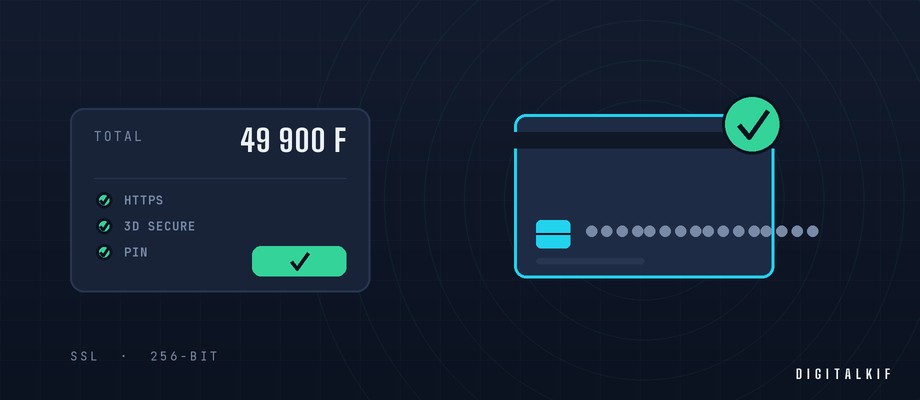
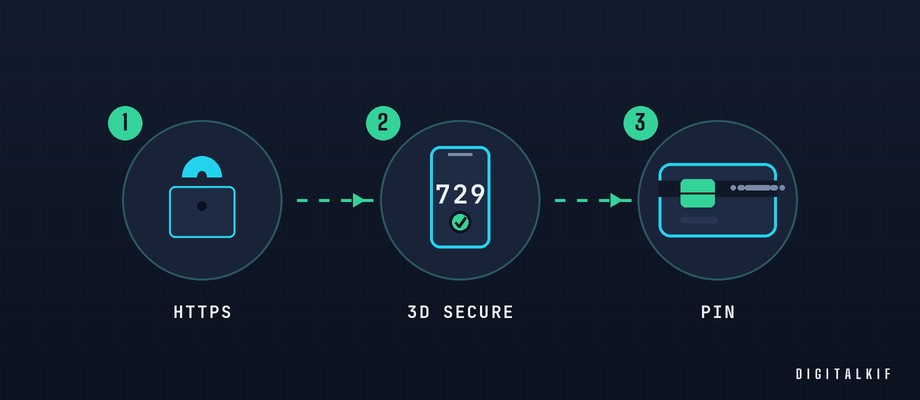
- The safeguard: enable 3D Secure with your bank. A code sent to your phone validates every purchase, so even if stolen, your card number stays useless. It works on the same principle as the two-factor authentication that protects your accounts.
- The alternative: favor solutions that never reveal your real card number, such as PayPal wallets, single-use virtual cards, or mobile money validated by a PIN code. If a dispute arises, you will also be better placed for a refund.
3. Secure Your Payment Environment
Even on a flawless site, paying from an unsafe network is like leaving a window open. The place, the moment, and the device you use matter just as much as the site itself. It is also safer to pay from a recent, up-to-date device that is better shielded against malware.
- The danger: never enter your banking details on a public Wi-Fi (café, airport, hotel), because your data can be intercepted there without you noticing. It is one of the hidden dangers of public Wi-Fi. Prefer your mobile connection (4G or 5G).
- Worth remembering: turn on your bank's notifications and check your statements regularly. At the slightest suspicious charge, block your card without waiting. Caught early, fraud usually does very little damage.
In short
Check the site, choose a protected payment method, and secure your network: these three habits quickly become second nature, and online shopping turns into a worry-free routine. Do you run an online store? Explore our maintenance and security services, or let's talk with DigitalKif: we are here to help.